
Hancock County Court Records After Arrest
In Hancock County, the arrest-to-court path has two records tracks. The booking track begins at the Hancock County Jail when jail staff process a person into custody. The court track begins when the Hancock County Prosecutor's Office reviews the allegation and files a criminal case, or when a court case is otherwise opened from a citation, warrant, or probable-cause filing. Those court records can show the State of Indiana as a party, the court name, the case number, charge descriptions, offense levels, filed dates, hearings, bond orders, warrant entries, disposition entries, and public document links when MyCase makes them available.
The jail booking record and the filed court charge do not have to match word for word. A booking may list an arrest allegation before prosecutor review. The prosecutor can file a different charge, add a count, reduce a count, decline a count, or amend the case later. For custody and booking detail, use the Hancock County jail inmate records path. For booking photos, use the Hancock County jail mugshots page. For filed charges, charge status, hearings, warrants, and final case action, use the court record.
Booking is not a conviction. A Hancock County arrest and jail booking show custody action. A conviction requires a plea, finding, or verdict in the court case.
Search Hancock County Court Records
Indiana's public court search route is MyCase, the statewide case-search portal for Indiana trial courts. The Indiana Judicial Branch Hancock County courts page also points users toward MyCase, local contacts, e-filing, statistics, and local rules. MyCase can show public non-confidential case information and many public documents, but the court help page cautions that not every document is online and that older cases or restricted matters may need clerk help.
The Indiana Supreme Court's MyCase search portal is the main online source for court records after a jail arrest in Hancock County.
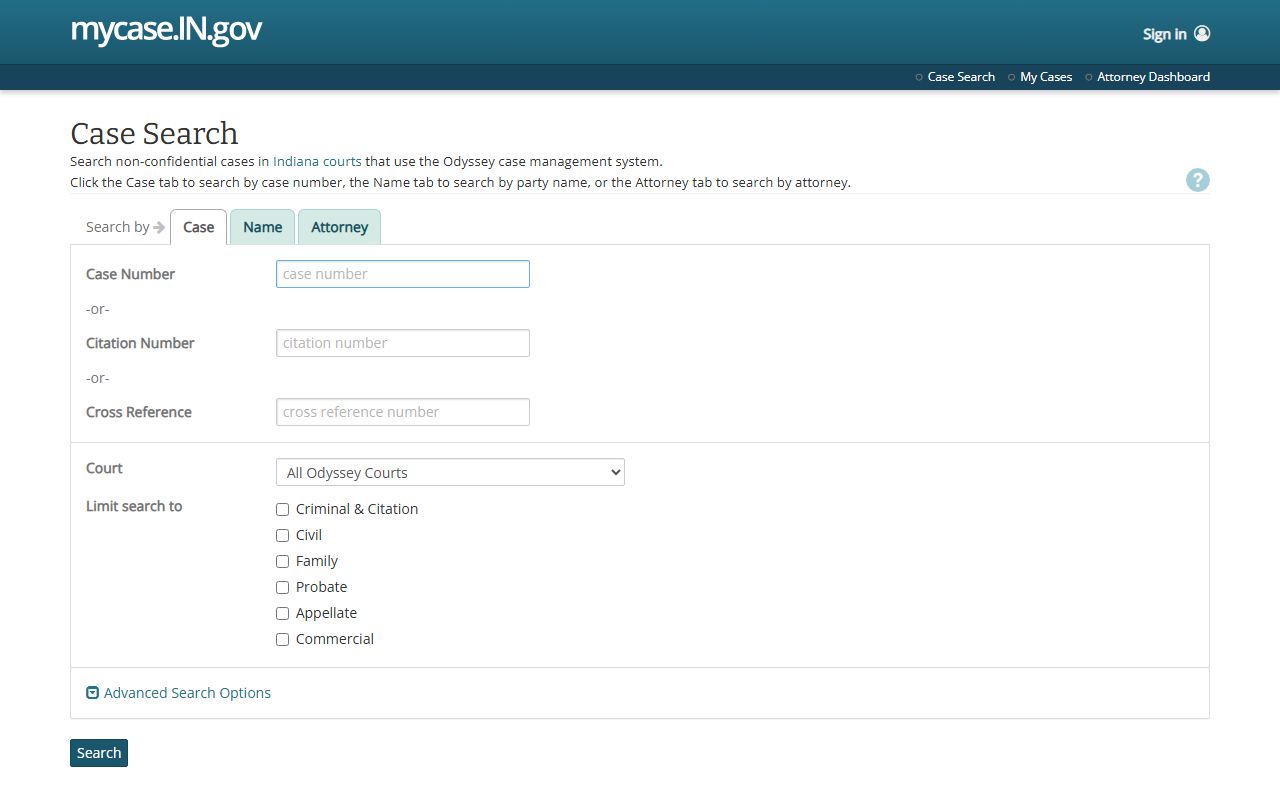
Use the court portal for filed charges and case events, then use the jail or sheriff records process only for custody records and booking material.
- Search by defendant name first if no case number is known. Narrow the result set to Hancock County when the filter is available.
- Search by case number if the number appears on bond paperwork, a citation, court notice, attorney letter, or public roster detail.
- Open the criminal case and review the chronological case summary for charges, hearings, warrants, bond orders, and disposition entries.
- Check document links. MyCase says many records are online at no cost, but a missing document link does not always mean the document is closed.
- Use the Hancock County Clerk public-access process when a public document is not linked or a certified copy is needed.
Hancock Court Records Search Fields
MyCase supports several search routes for public Hancock County court records after an arrest. The best field depends on what is known. A name search is useful soon after arrest when the family has no case number. A case-number search is cleaner once paperwork is available. Citation searches may help with traffic and infraction matters, and attorney searches can help when counsel is already listed.
| Field Label | Type | Required | Notes |
|---|---|---|---|
| Name | Text | No | Search by party or defendant name. Use Hancock County filters to cut down statewide false matches. |
| Case Number | Text | No | Best when jail, court, bond, citation, or attorney paperwork provides the exact number. |
| Citation Number | Text | No | Useful for traffic, infraction, and citation-based filings. |
| Attorney | Text | No | Available when searching by counsel rather than defendant name. |
| Court or County | Filter | No | Choose Hancock County when possible so unrelated Indiana cases are less likely to appear. |
| Case Type or Status | Filter | No | Public case categories can be narrowed, but sealed or expunged cases may not appear. |
Note: If MyCase does not show a case right after booking, the prosecutor may still be reviewing the arrest report or the public portal may not have updated yet.
Hancock County Charging Documents
A charging document is the paper that turns an arrest allegation into a filed court charge. In Hancock County, the prosecuting attorney represents the State of Indiana in criminal cases within the judicial circuit. The Hancock County Prosecutor's Office lists Brent E. Eaton as prosecuting attorney and describes the office's role as prosecuting state-law violations in courts with criminal jurisdiction. The prosecutor page also describes victim-centered prosecution, drug and behavioral health courts, child-support work, and law-enforcement partnership as local priorities.
The state-hosted Hancock County Prosecutor's Office page gives local context for the office that reviews many post-arrest cases in Hancock County.

The prosecutor's filing decision is the point where the court record becomes more important than the jail roster for charge status and case outcome.
| Document | Who Uses It | What It Does |
|---|---|---|
| Complaint | Law enforcement or prosecutor route | Starts or supports a criminal accusation after the arrest facts are reviewed. |
| Information | Prosecutor | States the formal charges the State of Indiana is pursuing in court. |
| Indictment | Grand jury route | Charges a case through a grand jury process, usually in more serious or complex matters. |
Hancock County Charge Status
Charge status can change after the first court filing. A count may start as pending, then be amended, reduced, dismissed, resolved by a guilty plea, resolved after trial, or followed by probation or a commitment to the Indiana Department of Correction. A release from jail does not resolve the court case by itself. A person can leave custody on bond while charges remain pending, and a person can be booked on a warrant tied to an older case rather than a new arrest allegation.
| Status | Plain Meaning | Record Caution |
|---|---|---|
| Pending | The charge is filed but not resolved. | Read hearing and bond entries for the next court event. |
| Amended | The charge wording, count, or citation changed. | Compare the current count with earlier filings before quoting it. |
| Reduced | The charge was lowered to a lesser offense. | The final conviction, if any, may be lower than the booking allegation. |
| Dismissed | That count ended without conviction. | Other counts in the same case may still be pending or resolved differently. |
| Convicted or Guilty Plea | The case has an adjudicated outcome on that count. | Use the exact count, level, and disposition date from the court record. |
| Commit to DOC | The sentence routes to state custody. | After transfer, use the Indiana Department of Correction locator, not the county roster. |
| Failure to Appear | A missed court event triggered court action. | It can lead to a bench warrant or new bond condition. |
Bond After Hancock County Arrest
The Hancock County Jail bond page states that bond amounts are determined by the court. The jail can accept bond after the court sets it, including through the jail lobby JailATM kiosk or the JailATM website. The county notes a $5 fee on criminal-case bonds, except for writs. If an inmate has a credit card or enough cash to cover the full bond amount, the county says the inmate may be able to bond themselves out.
Bond entries in court records should be read with care. A bond amount does not always mean release is available that day. A no-bond order, writ, detainer, warrant from another county, probation or parole issue, federal hold, or immigration issue can keep a person in custody even after local bond questions are answered. The court controls the amount and release conditions. The jail handles the custody processing after payment and after any other hold is cleared.
| Bond Route | How It Works | Hancock County Caution |
|---|---|---|
| Cash or full amount | Paid in the amount set by the court. | Confirm the amount and the $5 criminal-case bond fee before payment. |
| Credit card | Can be used by the inmate or through the lobby/online route. | Vendor fees may apply and are not the same as the court bond amount. |
| Personal recognizance | Release based on a promise to appear when the court orders it. | The Hancock jail page does not publish a separate PR-bond procedure. |
| No-bond or hold | Release is blocked until the court or holding agency clears it. | Call the jail or court before sending money when a hold is possible. |
Hancock County Warrant Records
The sheriff's Administration and Records page does not publish a separate active-warrant list. It directs people to verify active Indiana warrants through MyCase. That makes the court case the official public route for warrant-related entries in Hancock County. A bench warrant, arrest warrant, warrant recall, failure-to-appear entry, bond order, and new hearing date may appear in the case history when the entry is public.
Sheriff records and court records still serve different jobs. The sheriff's office can handle public sheriff reports and jail records through its records process, while the court and clerk control court filings, case documents, certified copies, and final dispositions. Active warrant data can change fast and may include law-enforcement-only details. A person who may have an active warrant should contact an attorney or the issuing court before appearing at a jail or courthouse based only on an online search.
Charges vs Convictions
An arrest, a booking charge, a filed charge, and a conviction are separate points in the Hancock County court record. Treating them as the same thing can lead to a bad reading of the file. Probable cause may support an arrest or filing, but a conviction requires a plea, finding, or verdict. A dismissed charge can remain visible in a public case history unless a later expungement or restricted-access order changes public access.
| Point in the Case | Charge | Conviction |
|---|---|---|
| Meaning | An accusation filed or listed in the case. | An adjudicated result on a specific count. |
| Stage | Can appear early after arrest. | Appears after plea, trial, or other final action. |
| Proof Level | Based on filing standards and probable-cause review. | Requires a plea or proof beyond a reasonable doubt. |
| Public Reading | Read status before drawing conclusions. | Read sentence, count, and disposition date together. |
Sealed and Expunged Records
Indiana law and court access rules limit some public records after arrest. The Access to Public Records Act supports inspection and copying of public records, but Indiana Code Title 5 also protects confidential records and allows some investigatory records to be withheld. Court records may be unavailable to the public if they are confidential, sealed, or expunged. MyCase help also notes that expungement can affect public access and that some public documents may still require a clerk request rather than an online download.
| Access Issue | Sealed or Confidential | Expunged or Restricted |
|---|---|---|
| Public View | Hidden or limited by rule, statute, or order. | Public access may be restricted after a qualifying court order. |
| Common Examples | Juvenile, paternity before 2014, victim-identifying, medical, and other confidential material. | Eligible arrest or conviction records under Indiana Code 35-38-9. |
| Where to Ask | Hancock County Clerk or the court handling the case. | The court and clerk process, often with legal advice. |
| Practical Limit | Some parties may need photo ID or notarized ID for confidential access. | An online case search may not show the full history after access is restricted. |
Hancock Court Record Copies
When MyCase does not link a public document, the Hancock County Clerk public-records request page gives the local copy route. The Public Access Department is listed at 9 E Main Street, Room 213, Greenfield, IN 46140. The research file identifies court case copies at $1 per page, certification at $3 per certification, and child-support payment printouts at $1 per year. The clerk page calls for a Request for Information form, a money order for the applicable fee, and a self-addressed stamped envelope. Requesters are told to contact Public Access first to determine the page count before mailing payment.
The Hancock County Clerk's court-record request page is the fallback for court records after an arrest when public MyCase document links are not enough.
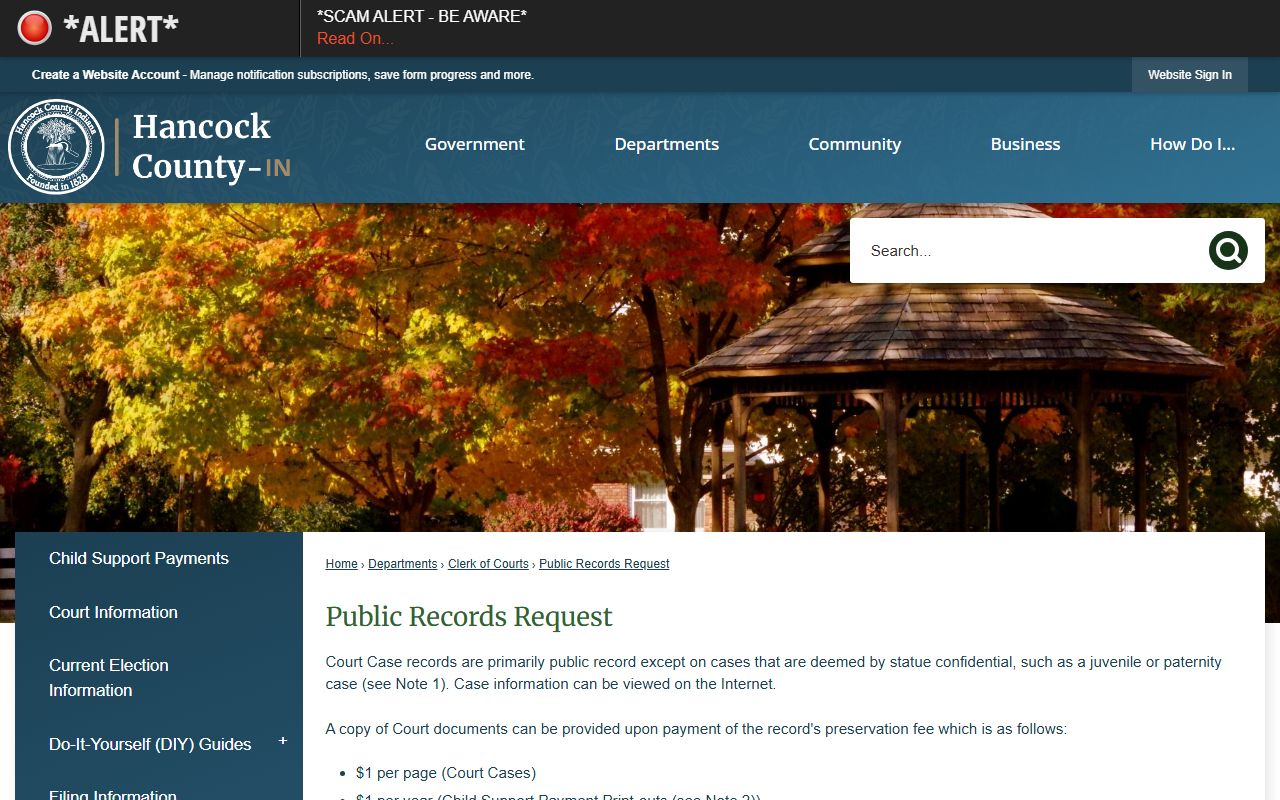
Use the clerk for court copies and certified dispositions, not for custody verification or jail booking photos.
Restricted Hancock Court Records
Not every record connected to an arrest is public. Juvenile cases, sealed cases, expunged matters, confidential family-related records, victim-identifying information, medical information, and some investigatory records may be withheld or limited. The clerk rules in the research file state that juvenile, paternity before 2014, and other confidential cases are provided only to parties, and those parties must provide photo ID. If a party cannot appear in person for certain confidential access, the clerk may require a notarized raised-seal copy of photo ID with the request.
For background-check decisions, use a legally compliant screening process. Casual court and jail searches are not the same as a consumer report, and they may be incomplete, outdated, or missing restricted records.
Important: Public lookup information is not a consumer report and may not be used for FCRA-covered decisions such as employment, housing, credit, or insurance.